 Luba
Luba Guides
How many chairs do you have free on a date? Avoid double booking your party rentals
Quick answer
- The chairs you have free on a date are the ones you own in good shape, minus everything that’s out at that moment: every booking that overlaps that date, plus anything that was due back and hasn’t come back.
- Watch the times: a booking that comes back Saturday at noon doesn’t free up chairs for a Saturday morning delivery.
- For a multi-day order, do the math for each day and go by the day that leaves you the fewest. Quotes don’t take chairs off the shelf, but give them a deadline, because if they all go ahead you come up short.
- A spreadsheet formula or an app like Luba does the math for you, and Luba warns you while you write down the booking if you don’t have enough.
Got an order right now? Do the math step by step.
We make Luba, the app in the “With Luba” boxes. The math, the formula and the tips work just as well without the app.
What you need: How many of each item you own, actually counted · Your bookings, with delivery and return dates and times · Paper, a spreadsheet or an app
-
Start with what you actually have
The math starts with how many pieces you own in good shape. If you bought 200 chairs but 6 are broken and 2 are out for repair, you have 192. The broken ones you keep counting are the ones you’ll be missing on the day of the event.
Every time a piece breaks or goes missing, take it off your list that same day. And every so often, do a real count: the number in your head is always higher than the real one.
NoteIf pieces break often, keep a few spares and don’t promise them: with 200 chairs, for example, book up to 195. They save you when a customer returns late or something breaks during loading.
-
Subtract everything that’s out at that moment
For the date you’re asked about, take two things off what you own:
Every booking that overlaps that date: the ones going out that day, the ones coming back that day, and the ones that left before and come back after.
Anything that was due back and isn’t: if a customer is late, you don’t have those pieces, even if their booking is over on paper.
And watch the times. A booking coming back Saturday at noon collides with a delivery on Saturday at 10 AM, even though both are “Saturday.” If one comes back Friday night and the other goes out Saturday morning, you can use the same chairs, as long as you have time to count and clean them.
An example with 200 folding chairs. Sarah wants 120 for Saturday, 10 AM to 10 PM:
Emily has 80 chairs from Friday at 7 PM and brings them back Saturday at noon. At 10 AM on Saturday she still has them, so they count.
David was supposed to bring back 20 chairs on Wednesday and hasn’t. They count too.
Free for Sarah: 200 minus 80 minus 20, so 100. She wants 120: you’re 20 short.
With LubaIn Luba, tap an item in Things: at the top you see how many are free today and, under Coming up, every upcoming booking with how many stay free while it lasts, including what wasn’t returned on time (“Was due back…”) and what’s Pending.
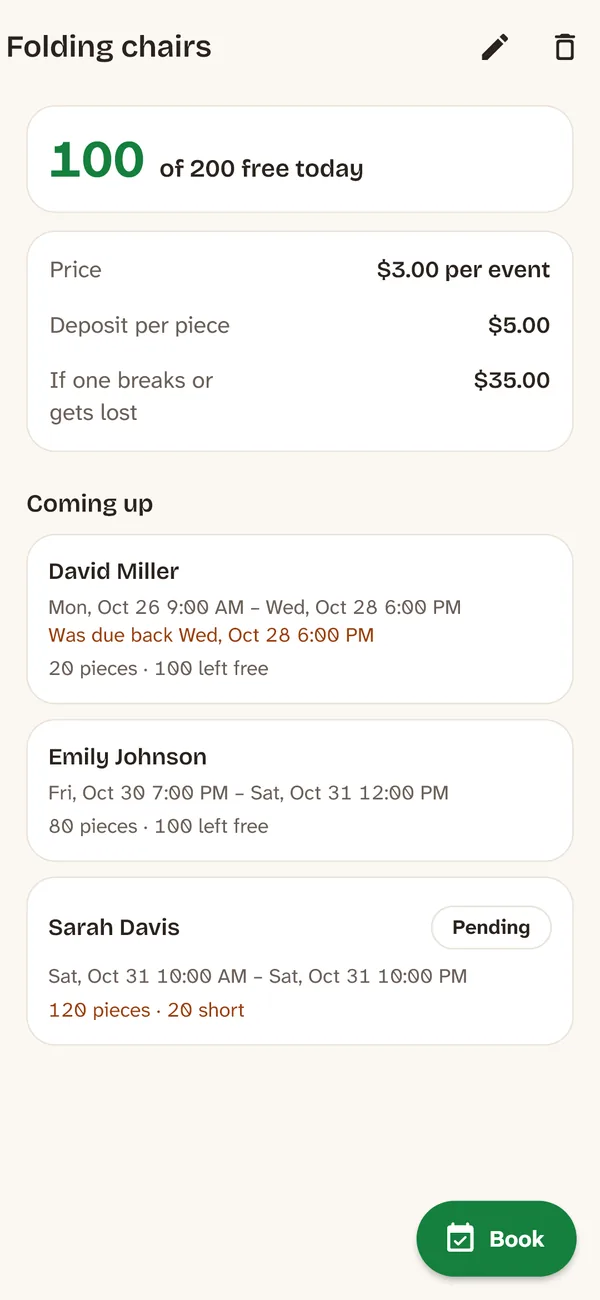
How many stay free during each upcoming booking. -
For a multi-day order, look at the busiest moment
When someone wants chairs from Friday to Sunday, do the math for each day (and each time of day when something changes) and go by the lowest number. That moment decides whether you have enough.
Don’t add up every booking of the week: 30 chairs out on Saturday and 50 on Sunday are never out at the same time. For a Saturday-to-Sunday order, those bookings tie up 50 chairs at most, not 80. If you add them up, you turn down orders you could have taken.
-
Decide what to do with quotes
A quote isn’t a booking: if you count it as out, you turn customers away for an order that may never come. But if you ignore it and it goes ahead, you’re short.
The practical way is to write it down anyway, check whether you’d still have enough if it’s confirmed, and give it a deadline: “I’ll hold them until Thursday at noon.” Many rental companies only lock in the date once the customer pays a deposit. If another order comes in for the same date, check with the person who got the quote first.
With LubaIn Luba, a Pending booking works as a quote: it doesn’t hold anything, but if it overlaps another one, the app tells you, for example with “Fits, but 20 short if pending bookings are confirmed.”
-
Do the math on paper or with a formula
On paper: one sheet per item, with a calendar. On each day, write how many go out and who has them. It works if you have a few bookings a week.
In a spreadsheet: one row per booking, with the delivery date in column A, the return date in column B (dates only, no times) and the number of chairs in column C. This formula, in Excel or Google Sheets, adds up the chairs that are out on the date in cell H1:
=SUMIFS(C:C, A:A, "<="&H1, B:B, ">="&H1)
Subtract it from what you own. Keep in mind that it counts by day, not by hour, and it doesn’t see late returns: add those yourself. If you also track bookings that aren’t confirmed yet, add a status column so you can see both numbers.
-
If you’re short, say so before you promise
Telling the customer right away beats letting them down on the day of the event. You have a few ways out:
Offer what you have: 100 chairs often work just as well, or they fill in with their own.
Another style: if you’re 20 folding chairs short, maybe you have 20 of another kind.
Sub-rent from another company: if another rental business lends you the ones you’re missing, write them down as a booking of their own, so you remember to give them back.
A text you can copy:
“Hi Sarah, for Saturday I have 100 folding chairs available out of the 120 you need. Would 100 work, or should I fill in with 20 chairs in another style?”
With LubaIn Luba, while you write down the booking, the app shows how many are free on those dates. If you’re short, it tells you with “20 short on these dates” and offers Set 100, the ones you do have.
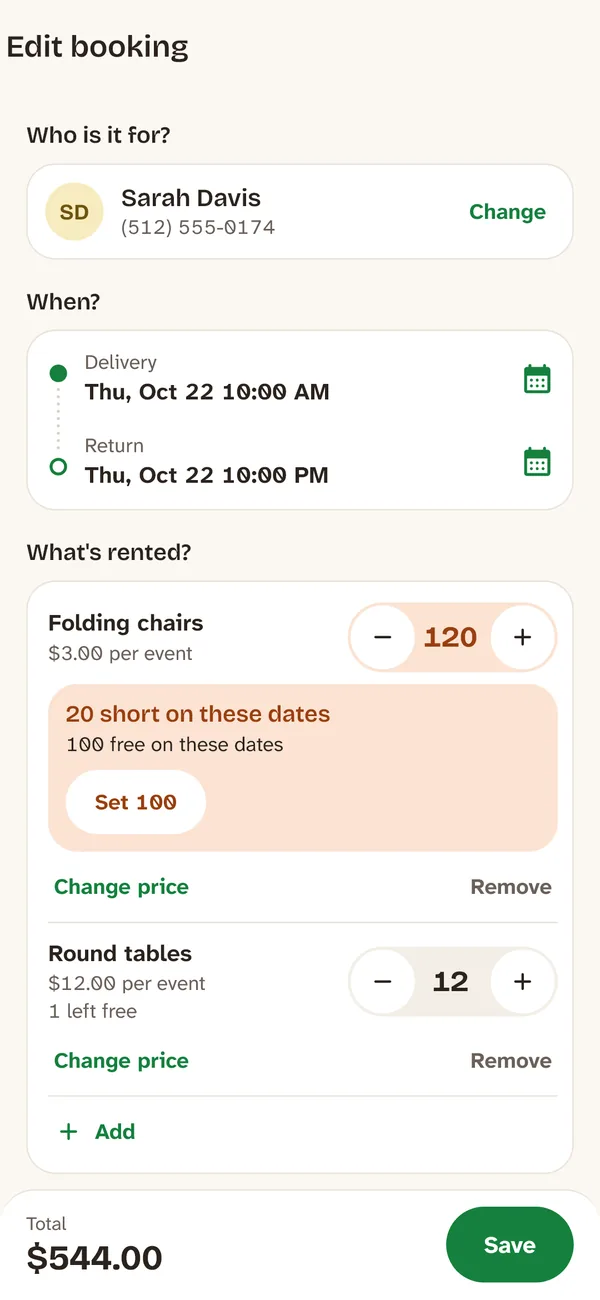
While you write the booking down, Luba tells you if you have enough. 
Mistakes that lead to double booking
Counting chairs from memory
Broken and missing pieces you never took off your list make you promise chairs you don’t have.
Forgetting what hasn’t come back
If a customer returns late, those pieces aren’t there for the next booking.
Looking at the day and not the time
A Saturday noon return doesn’t cover a Saturday morning delivery.
Adding up every booking of the week
You end up turning down orders that would have fit. Look at the busiest moment.
Holding quotes with no deadline
Chairs stay “held” for someone who never confirms, and you lose another customer.
Saying yes and finding the rest later
If no one can lend you chairs at the last minute, you let the customer down on the day. Line them up before you confirm.
Frequently asked questions
How do I know how many chairs I have available on a date?
Take the chairs you own in good shape and subtract every booking that’s out at that moment, plus any chairs that were due back and haven’t come back. Watch the times: a noon return doesn’t cover a morning delivery.
How do I avoid double booking party rentals?
Write down every booking as soon as it comes in, with delivery and return dates and times, and before you say yes, check how many are free at that moment. Take broken or missing pieces off your list the same day.
Should I count quotes that aren’t confirmed yet?
They don’t take chairs off the shelf, but check whether you’d still have enough if they go ahead, and give them a deadline, for example Thursday at noon. Many rental companies only lock in the date with a deposit.
What spreadsheet formula shows how many chairs are booked on a date?
With the delivery date in column A, the return date in column B (no times), the chairs in column C and the date you’re checking in H1: =SUMIFS(C:C, A:A, "<="&H1, B:B, ">="&H1). Subtract it from what you own. It counts by day, not by hour, and late returns have to be added separately.
What do I do if a customer wants more chairs than I have?
Tell them right away and offer what you have, another style of chair, or chairs you sub-rent from another company. It beats letting them down on the day of the event.
Is there an app that tells me how many chairs I have free?
Yes. Luba, by RollanSoft, keeps your rentals in order from your phone. While you write down a booking, it shows how many are free on those dates, counting late returns and quotes, and warns you if you’re short. It’s free for 10 kinds of items (100 chairs count as one), with no ads and no account.