 Luba
Luba Guides
Security deposits for party rentals: how much to charge and how to deduct damage
Quick answer
- A security deposit is money the customer leaves before taking your chairs, tables or dishes. You refund it when everything comes back in good shape; if something comes back broken or doesn’t come back, you deduct the replacement cost and refund the rest.
- Charge it per piece, so it covers what usually breaks at an event, not the cost of replacing everything. A good starting point is 10% to 30% of each piece’s replacement cost: for example, $5 for a folding chair that costs $35 to replace.
- Before delivery, put the deposit and the replacement cost of each piece in writing. Count together at delivery and again at return.
- With an app like Luba, each booking adds up its deposit for you, and at the return the app suggests the damage amount and how much to give back.
Need it now? Copy the text with the terms.
We make Luba, the app in the “With Luba” boxes. The math, the text and the tips work just as well without the app.
What you need: A list of what you rent out · What it costs you today to buy another of each piece · Your phone, to text the terms
-
Put a price on every broken or missing piece
Before you set a deposit, decide what you charge when a piece comes back broken or doesn’t come back. That’s the replacement cost: what it costs you today to buy another one, shipping included. Not what you paid years ago.
Write it next to each item on your list. With the price in writing, you don’t have to come up with a number at the return, with the customer standing there.
If it can be fixed, charge for the repair, not a new piece: a table with a loose leg, a tablecloth with a stain that comes out with a special wash. Normal wear and tear, like a scuffed chair or a tablecloth that’s faded from washing, isn’t charged. It comes with renting.
-
Decide how much deposit to ask
The fairest way is an amount per piece: someone who takes 200 chairs leaves more than someone who takes 20. Multiply each item’s deposit by how many they take, and add it up.
It doesn’t have to cover replacing everything. Ask for that and few people will book with you. It has to cover what usually breaks or goes missing at an event, and give the customer a reason to be careful. A good starting point is 10% to 30% of the replacement cost: higher for what breaks often, like glasses and plates, and lower for what almost never breaks, like tables and tents. Then adjust it to what actually breaks in your business.
An example, with made-up prices:
Folding chairs: $5 deposit per chair. $35 if one breaks or goes missing.
Round tables: $25 per table. Broken or missing, $150.
White tablecloths: $10 per tablecloth. Ruined or missing, $40.
Large tent: $300. If it has to be replaced, $2,500.
Wine glasses: $2 per glass. Broken or missing, $8.
Dinner plates: $2 per plate. Broken or missing, $10.
At those amounts, 100 chairs take a $500 deposit, and 60 glasses with 60 plates, $240.
NoteMany party rental companies also offer a damage waiver: a non-refundable fee, often 5% to 15% of the order, that covers small accidental damage, like a chipped plate or a stained tablecloth, but not missing or stolen items. You can use it instead of a deposit or on top of one. Either way, write down exactly what it covers.
NoteIf you ask a regular customer for less, or cap the deposit on a big order, the replacement cost stays the same: whatever goes past the deposit is paid separately. Say so from the start.
With LubaIn Luba, each item has its Deposit per piece and what it costs If one breaks or gets lost. When you write down a booking, the app adds up the deposit for everything in it. If you agree on a different amount, change it in Deposit.
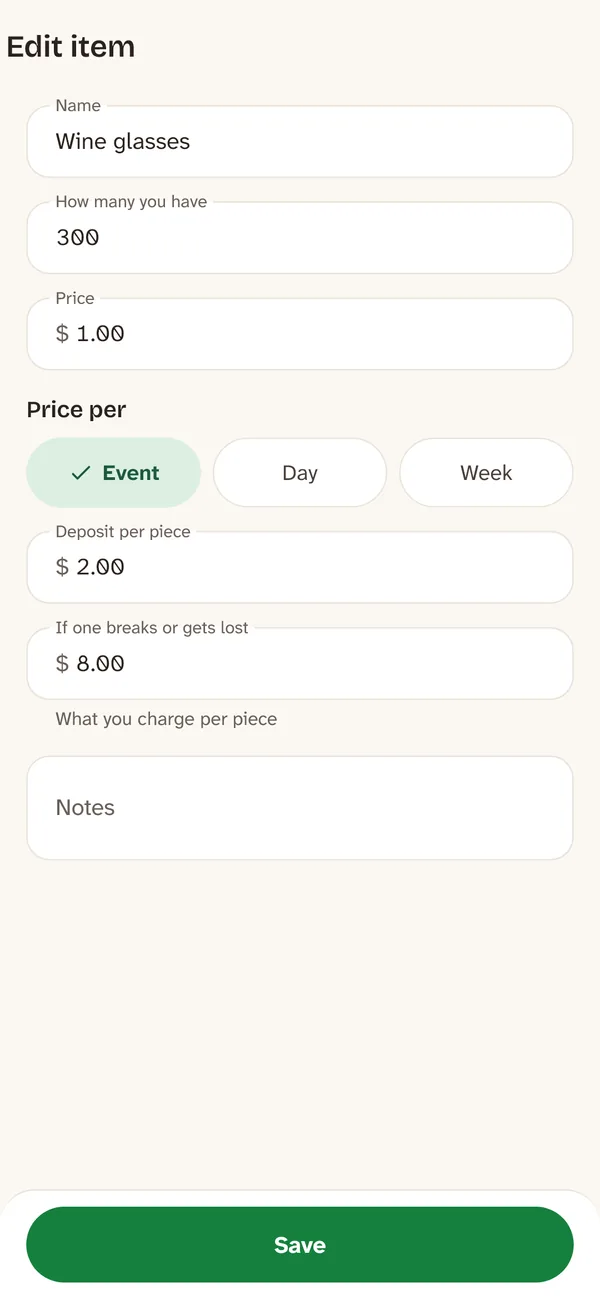
The deposit per piece and what it costs if one breaks or goes missing. -
Text the terms before delivery
Before anything leaves, the customer should know how much the deposit is, what each piece costs if it breaks or goes missing, and when they get their money back. A text is enough, and it leaves a record in case there are questions later.
A text you can copy and change:
“Hi Michael, confirming your order: 60 wine glasses and 60 dinner plates, Friday 10 AM to Saturday 8 PM. The security deposit is $240, refunded when everything comes back in good shape. Anything broken or missing comes out of the deposit at replacement cost: $8 per glass and $10 per plate. Reply OK if that works for you.”
Add whatever tends to cause questions in your business: whether dishes come back rinsed or not, whether you charge to clean wax or wine off a tablecloth, or what happens if they return late.
NoteThis text makes clear what you agreed on, but it isn’t a rental agreement. If you want one, talk to a lawyer in your state.
With LubaIn Luba, Send by WhatsApp, inside the booking, sends the customer what they’re taking, the dates, the total and the deposit. Add the replacement costs yourself before you send it.
-
Take the deposit and count together at delivery
Collect the deposit before anything goes out or at delivery: cash, Zelle, Venmo or card. Bigger companies often put a hold on a credit card instead. Give a receipt that says it’s a deposit, not rent, so no one mixes them up later.
Count together with whoever receives the order, and look closely at what could cause questions: tablecloths, tables, the tent. If something already has a mark, say so and take a photo. That way, no one argues at the return about whether it was already like that.
With LubaIn Luba, record the deposit in the booking with Record a payment and choose Deposit under What you receive: it gets its own receipt to send. Under Photos, keep the ones from When it goes out.
-
Check everything in front of the customer at return
Count again, item by item, and set aside what came back broken or didn’t come back. Do it in front of the customer or whoever brings it back: damage that shows up days later is hard to claim.
For what you can’t check on the spot, like a stained tablecloth you’re about to wash, let them know the same day, with a photo. If the stain comes out in the wash, you don’t charge anything.
If something is missing, ask before you charge for it: sometimes a crate is left at the venue or at the customer’s house and comes back the next day.
-
Deduct the damage and refund the rest
Add up what’s broken or missing at the replacement cost you told them, subtract it from the deposit and refund the rest. With the example of 60 glasses, 60 plates and a $240 deposit:
Damage: 2 broken glasses at $8 is $16, and 1 missing plate, $10. $26 in all.
You give back: $240 minus $26, so $214.
If the customer still owed part of the rental, deduct that too. If the damage is more than the deposit, show them the math and ask for the difference.
Refund the deposit the same day if you can, with a receipt that says how much you deducted and why. If you need to wash the linens to check them, tell the customer which day they’ll get it back, and keep your word.
With LubaIn Luba, Receive return shows how many of each item went out. You mark how many are Returned broken or Lost, and the app suggests the damage amount at replacement price and the amount under You refund, after taking off anything the customer still owed. Choose how you give it back and tap Finish booking: the refund gets its own receipt, showing the damage, the deposit you received and what you gave back.
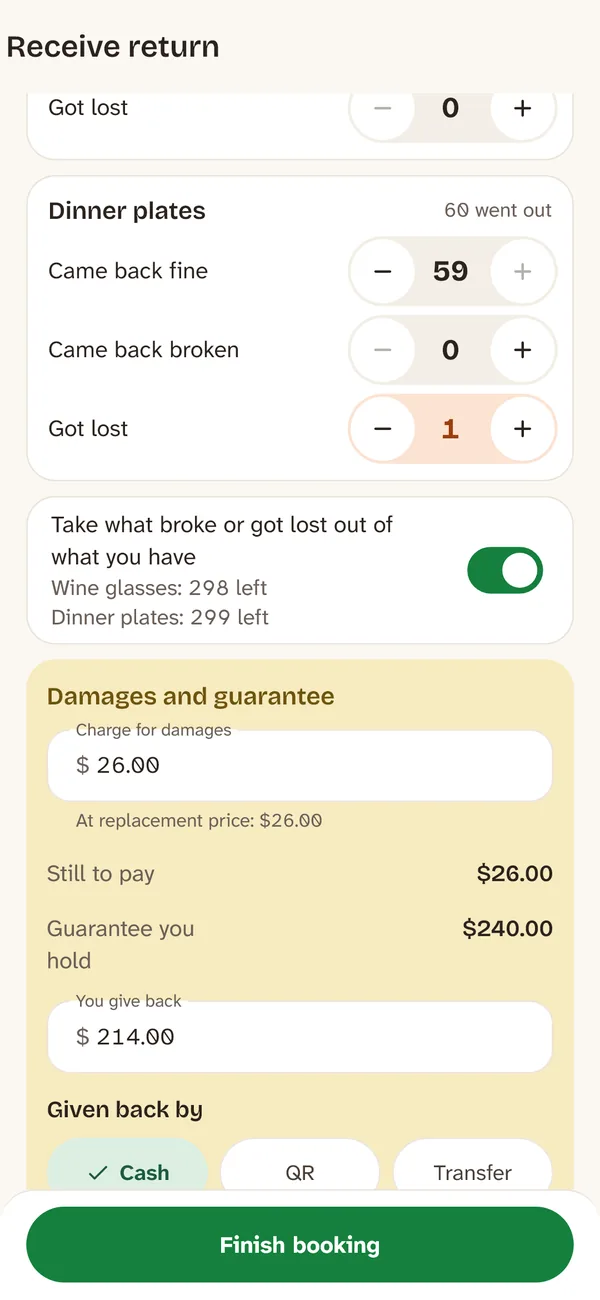
Damage at replacement price and what you give back from the deposit. 
Mistakes that end in an argument
Naming the price of broken pieces only at the return
It feels made up on the spot. Put it in writing before delivery.
Asking for a deposit so high the customer walks away
It doesn’t have to cover replacing everything, just what usually breaks. Anything beyond that is paid separately, at the price you told them.
Delivering without counting
If you don’t know how many went out, you can’t claim the ones that are missing.
Checking the linens days later without saying so
If you’ll check them when you wash them, say so at the return and send the photo that same day.
Keeping the whole deposit over a small chip
Deduct only what it costs to replace or fix, with the math in plain sight. A customer who feels overcharged doesn’t book again.
Mixing the deposit with the rental payment
Record them separately and give a receipt for each. Otherwise, at the end no one knows how much to refund.
Frequently asked questions
How much should I charge for a security deposit on party rentals?
An amount per piece that covers what usually breaks or goes missing, not the cost of replacing everything. A good starting point is 10% to 30% of each piece’s replacement cost, for example $5 for a folding chair that costs $35 to replace. Put it in writing before delivery.
How much deposit should I ask for 100 chairs?
Multiply the deposit per chair by 100. At $5 per chair that’s $500, which covers up to 14 broken or missing chairs at $35 each. Anything beyond the deposit is paid separately, at the replacement cost you told the customer.
What is a damage waiver on a party rental?
A non-refundable fee, often 5% to 15% of the order, that covers small accidental damage like a chipped plate or a stained tablecloth. It usually doesn’t cover missing or stolen items, which are charged at replacement cost. Some rental businesses use it instead of a security deposit, others on top of one.
How much do I charge for a broken chair or a missing plate?
What it costs you today to buy another one: the replacement cost. If it can be fixed, charge for the repair. Normal wear and tear isn’t charged.
When should I refund a party rental deposit?
Once everything is back and checked, ideally the same day. If you need to wash the linens to check them, tell the customer which day they’ll get it back. Refund it with a receipt that says how much you deducted and why.
What if the damage costs more than the deposit?
Show the customer what’s broken or missing at the replacement cost you told them, keep the deposit and ask for the difference. Give them a receipt when they pay it.
Is there an app that tracks deposits and damage for party rentals?
Yes. Luba, by RollanSoft, keeps your rentals in order from your phone. It adds up the deposit for each booking and, at the return, suggests the damage amount at replacement price and how much to give back, with a receipt. It’s free for 10 kinds of items (100 chairs count as one), with no ads and no account.