 Luba
Luba Guides
Dish rental checklist: how to count every piece out and back in, and handle breakage
Quick answer
- Most dish rental disputes start with no one knowing how many pieces went out. Keep every item in racks or crates that always hold the same count, so you count racks instead of hundreds of plates, and write down how many of each item leave.
- At delivery, the customer signs that checklist. At pickup, count together rack by rack and set aside anything broken, chipped or missing.
- Deduct breakage from the deposit at the replacement cost you quoted up front, and take it off your inventory the same day, so you don’t book pieces you no longer have.
- With an app like Luba, you mark what came back fine, broken or lost on your phone: the app suggests the deduction and tells you how many pieces you have left.
Need it now? Get the printable checklist.
We make Luba, the app in the “With Luba” boxes. The checklist, the math and the tips work just as well without the app.
What you need: The printable checklist (below, in Word and PDF) · Glass racks, dish racks or crates · What it costs you today to replace each piece
-
List every item with its replacement cost
A dish rental order is a lot of different pieces: dinner, salad and dessert plates, cups and saucers, wine glasses, water goblets and champagne flutes, flatware, platters and pitchers. Make a list with one row per item and, next to it, what it costs you today to buy another one. That’s the replacement cost: what you charge if it breaks or goes missing.
Download the printable checklist in Word or as a PDF. It’s one letter-size page: the customer, dates and deposit at the top; one row per item in the middle, with how many went out, came back OK, broken and missing; and signatures at delivery and pickup at the bottom. The most common items are already printed: swap in your own in Word and fill in the replacement costs once.
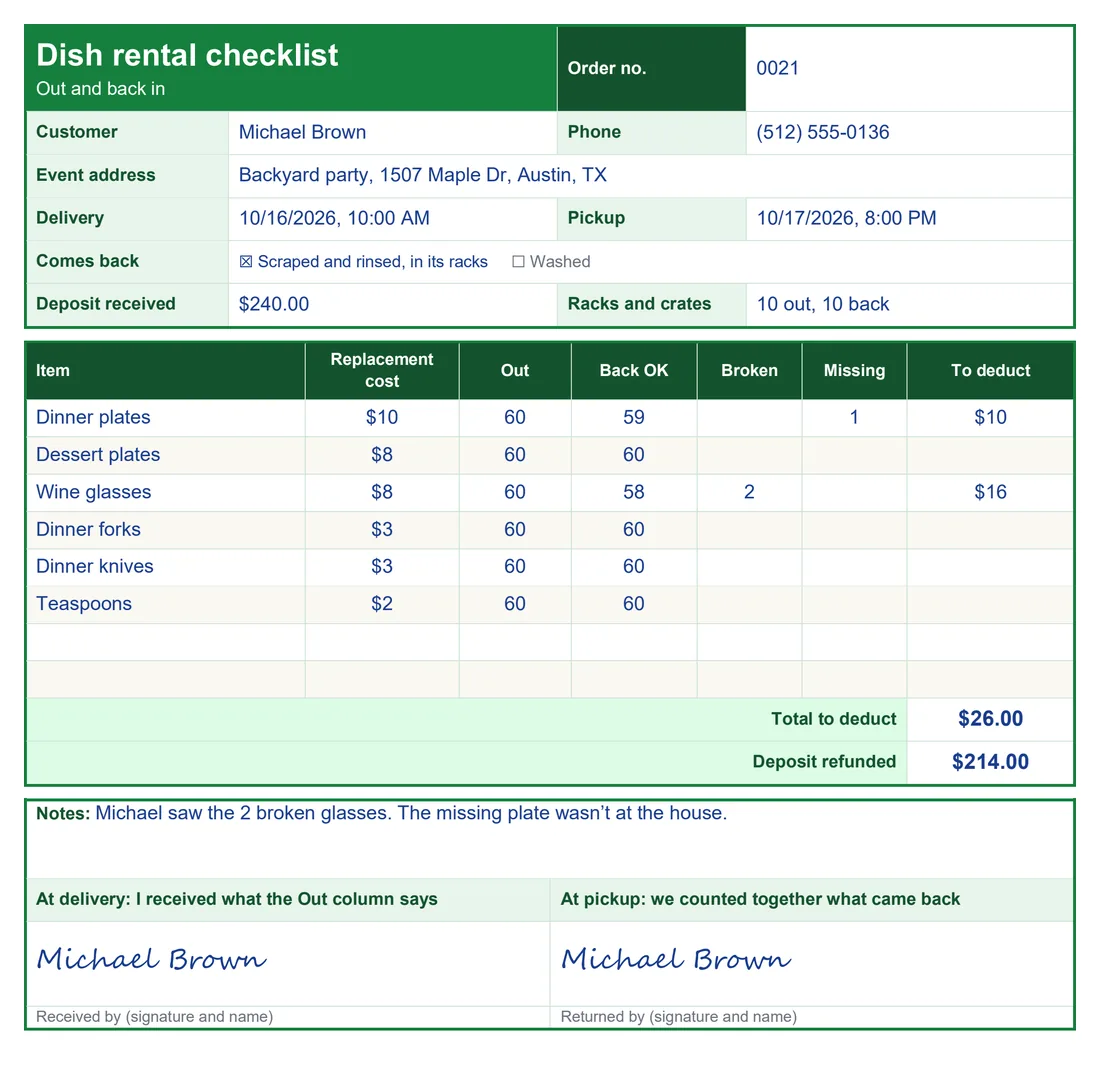
The checklist after pickup. With LubaIn Luba, each item you rent out has what it costs If one breaks or gets lost, and the app uses that price on every return.
-
Store everything in racks with a fixed count
Counting 600 pieces one by one with the customer waiting doesn’t work. What works is every rack or crate always holding the same number: say, 25 wine glasses in a compartment rack, 20 dinner plates in a dish rack or 50 forks in a flatware bin. You count racks and multiply, and only count piece by piece in the rack that isn’t full.
Label each rack with what’s in it and how many, and mark the partial one so it stands out. 60 wine glasses go out as two full racks of 25 and one with 10.
Glasses each get their own compartment, never stacked. Compartment racks also prevent most breakage on the road.
NoteUse the same count per rack across your whole business, and don’t change it. If a 25-glass rack goes out with 24 one day, at pickup no one knows whether a glass is missing.
-
Check and count before delivery, and get a signature
Before loading, look at every piece: a chipped plate or a glass with a nicked rim shouldn’t go out. It can cut someone, and later no one knows whether it was already like that. Pull it and replace it.
Fill in the “Out” column, count the racks together with whoever receives the order, and have them sign at the bottom, under “At delivery.” If something goes out with a mark that doesn’t affect use, like a scuffed plate, write it under “Notes” and take a photo.
The same day, text the customer what they’re getting, the deposit, the replacement cost of each piece and how the dishes should come back (see the next step). That puts it in writing before the event.
With LubaIn Luba, Send by WhatsApp, inside the booking, sends the customer what they’re taking, the dates, the total and the deposit. Add the replacement costs yourself before you send it. Under Photos, keep the ones from When it goes out.
-
Agree on how it comes back: scraped, rinsed and in its racks
Decide ahead of time whether dishes come back dirty, rinsed or washed, and put it in writing. Many rental companies only ask for dishes scraped and rinsed, back in their original racks, and do the washing themselves. It makes sense: you have to wash and inspect every piece before the next event anyway, and a rushed wash by the customer means double work for you.
If you want dishes back washed, say what you charge for a dirty return, and charge the same every time. Some companies do it the other way around: they add a cleaning charge to the order and refund part of it when everything comes back rinsed.
Wash what comes back the same day or the next. Dried food is harder to get off and leaves stains.
-
Count rack by rack in front of the customer
Count the racks first. Then open each one: if it’s full and nothing is broken, move on; if not, count piece by piece. Write down how many came back OK, broken and missing, and have the customer sign under “At pickup.”
A chipped or cracked piece counts as broken, because you can’t rent it out again. Say so in your text before delivery so it isn’t a surprise.
Keep the broken pieces until the customer sees them, or text a photo the same day. It’s the easiest way to avoid an argument.
If something’s missing, don’t charge for it on the spot: a crate often gets left in the venue’s kitchen or at the customer’s house and turns up the next day. Note what’s missing and how long you’ll wait, and only then deduct it.
With LubaIn Luba, Receive return shows how many of each item went out, and you mark how many are Returned OK, Returned broken or Lost. If a crate comes back later, save just what arrived: the booking stays active, showing how many are still out, until everything is back. Under Photos, keep the ones from When it comes back.
-
Deduct breakage and take it off your inventory
Add up what’s broken or missing at the replacement cost you quoted, subtract it from the deposit and refund the rest. With the sample checklist and a $240 deposit:
Broken: 2 wine glasses at $8, $16.
Missing: 1 dinner plate, $10.
You give back: $240 minus $26, so $214.
Then take the broken pieces off your inventory the same day: if you had 300 wine glasses, you now have 298. Skip it, and next weekend you’ll book 300 glasses and come up short. Replace breakage before a big event, and keep an eye on what breaks most: if you lose glasses every month, raise their deposit or buy a few extra.
NoteSome rental companies also charge a damage waiver: a small non-refundable fee that covers ordinary breakage, like a chipped plate or a broken glass, but not missing pieces. If you offer one, say exactly what it covers.
With LubaIn Luba, once everything is back, the app suggests the damage at replacement price and the amount under You refund. Remove broken and lost items from inventory is already on and shows what’s left, like “Wine glasses: 298 left.” Tap Finish booking and you get a receipt for the refunded deposit.
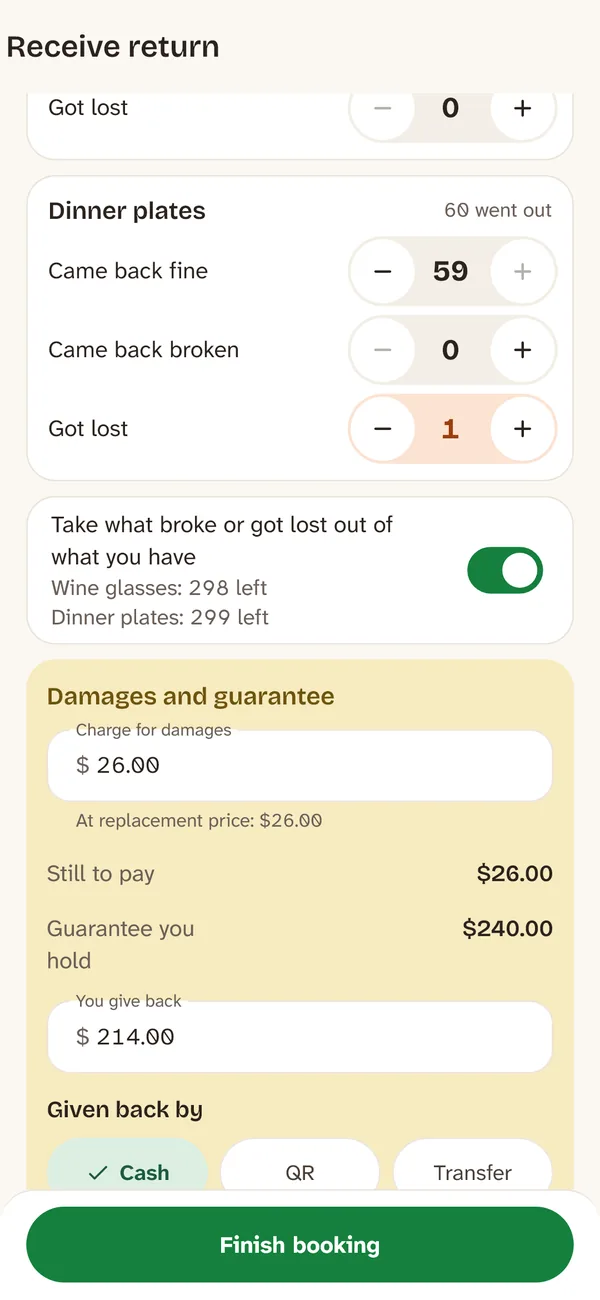
Breakage comes off your inventory, and the app suggests what to give back. 
Mistakes that cost you pieces
Counting 600 pieces one by one
With fixed-count racks you count racks, and only go piece by piece in the partial rack or the one with something broken.
Sending out chipped pieces
They can cut someone, and at pickup no one knows whether they were already chipped. Pull them before loading.
Taking racks back without opening them
Breakage turns up after the customer has left. Open every rack in front of them.
Charging for missing pieces on the spot
They often turn up at the venue the next day. Note what’s missing and wait a day before deducting it.
Forgetting to take breakage off your inventory
Next weekend you book pieces you no longer have.
Changing how many go in each rack
If a 25-glass rack goes out with 24 one day, it looks like a glass is missing at pickup.
Frequently asked questions
How do I keep track of rented dishes?
With a checklist for each order: one row per item, with how many went out, came back OK, broken and missing, signed by the customer at delivery and at pickup. Store dishes in racks that always hold the same count, so you count racks instead of pieces.
How much should I charge for a broken or missing dish?
What it costs you today to buy another one: the replacement cost. Quote it in writing before delivery and deduct it from the deposit.
Does a chipped plate count as broken?
Yes, if you can no longer rent it out, which is almost always the case with a chipped plate or a glass with a nicked rim. Say so before delivery so it isn’t a surprise.
Do you have to wash rental dishes before returning them?
It depends on the rental company. Many only ask for dishes scraped and rinsed, back in their original racks, and wash them themselves. Check the rental terms, and if you’re the one renting out dishes, put your rule in writing before delivery.
What if dishes are missing after an event?
Ask before charging: a crate often gets left at the venue or the customer’s house. Note what’s missing and wait a day. If it doesn’t turn up, deduct it from the deposit at the replacement cost you quoted.
Is there an app to track a dish rental business?
Yes. Luba, by RollanSoft, keeps your rentals in order from your phone. At each return you mark what came back fine, broken or lost; the app suggests the deduction at replacement price, takes broken pieces off your inventory and makes a receipt for the refunded deposit. It’s free for 10 kinds of items (300 glasses count as one), with no ads and no account.